What the EU Cyber Resilience Act Means for Automated Warehouses
For companies deploying warehouse automation in Europe, cybersecurity is becoming part of market access, supplier evaluation, and long-term investment protection.
As automated warehouses become more connected, customers need more than general cybersecurity claims. They need to know whether the systems they deploy are designed, documented, assessed, and supported with cyber resilience in mind.
This is where the EU Cyber Resilience Act, or CRA, becomes important.
For automated warehouses, CRA is not only a regulatory topic. It is changing how customers evaluate automation partners, how suppliers demonstrate cybersecurity readiness, and how connected products are supported throughout their lifecycle.
CRA is Changing the Cybersecurity Conversation
The Cyber Resilience Act introduces mandatory cybersecurity requirements for hardware and software products with digital elements made available on the EU market. It requires manufacturers to consider cybersecurity across the product lifecycle, from planning, design, and development to maintenance, vulnerability handling, and post-market support.
For warehouse automation, this is a meaningful shift.
Modern ASRS solutions are no longer isolated machines. They are connected systems made up of robots, control software, workstations, charging systems, APIs, data interfaces, remote service capabilities, and integrations with warehouse management or enterprise systems. These technologies help customers improve throughput, space utilization, flexibility, and operational visibility.
But under CRA, the question is no longer only whether a system performs well.
Customers and partners will increasingly need to understand whether the system has been developed through secure processes, whether its security capabilities are documented, and whether the supplier can continue managing cybersecurity risks after deployment.
That changes the role of the automation supplier. Cybersecurity can no longer be treated as a late-stage technical review or a response to a customer questionnaire. It needs to be embedded into product development, supported by clear documentation, and managed throughout the product lifecycle.
For warehouse automation customers, this makes cybersecurity more concrete. It becomes something that can be reviewed, compared, and used as part of vendor selection.
Why CRA Readiness Matters Now
The CRA entered into force on 10 December 2024. Its reporting obligations will apply from 11 September 2026, while the main obligations will apply from 11 December 2027.
At first glance, this may sound like a future requirement. But for warehouse automation projects, the timeline is already relevant.
ASRS systems are long-term investments. A system being evaluated or deployed today may still be operating when CRA requirements become fully applicable. The project lifecycle itself can also be long, involving solution design, technical validation, site planning, integration, testing, training, and post-deployment support.
That means CRA readiness is becoming part of today’s vendor evaluation.
For customers operating in Europe, or planning to deploy automation across European facilities, early supplier readiness can reduce uncertainty during procurement, compliance review, internal security assessment, and future system expansion.
CRA should not be viewed only as a regulatory deadline. It is becoming part of how customers define a future-ready automation partner.
A supplier that prepares early can help customers move through project approval with greater confidence. A supplier that waits until the deadline may create extra review work, documentation gaps, or delayed compliance discussions for customers and partners.
What Customers Should Expect from Automation Suppliers
CRA places stronger expectations on manufacturers of products with digital elements. Before placing a product on the market, manufacturers are expected to assess cybersecurity risks, implement relevant cybersecurity requirements, prepare technical documentation, and complete the required conformity assessment process.
After market placement, they are expected to manage vulnerabilities during the indicated support period and report certain cybersecurity incidents and actively exploited vulnerabilities.
For a warehouse automation provider, this is not a minor documentation exercise.
It requires a structured way to manage product security across hardware, software, firmware, interfaces, updates, third-party components, and service workflows. It also requires clearer evidence that security is not handled informally or only at the end of development.

For customers, this means cybersecurity evidence will become a more regular part of automation procurement.
Customers may increasingly ask suppliers to explain how product security risks are assessed, how vulnerabilities are handled, how long products will be supported, how updates are managed, and what documentation can support compliance review.
These questions are not only for legal or IT teams. They are also relevant to operations, procurement, engineering, and leadership because they affect the long-term usability of automation assets.
When a warehouse operator invests in a robotic storage system, the concern is not only whether the system is secure on installation day. The concern is whether the supplier can continue supporting the product as threats evolve, software changes, integrations expand, and regulatory expectations become more mature.
That is why CRA readiness should be seen as part of supplier reliability.
A mature automation partner should be able to show that cybersecurity is managed through repeatable processes, not one-off responses. It should also be able to provide clearer documentation for customer-side review, integrator collaboration, and market access requirements.
The Role of Standards in CRA Readiness
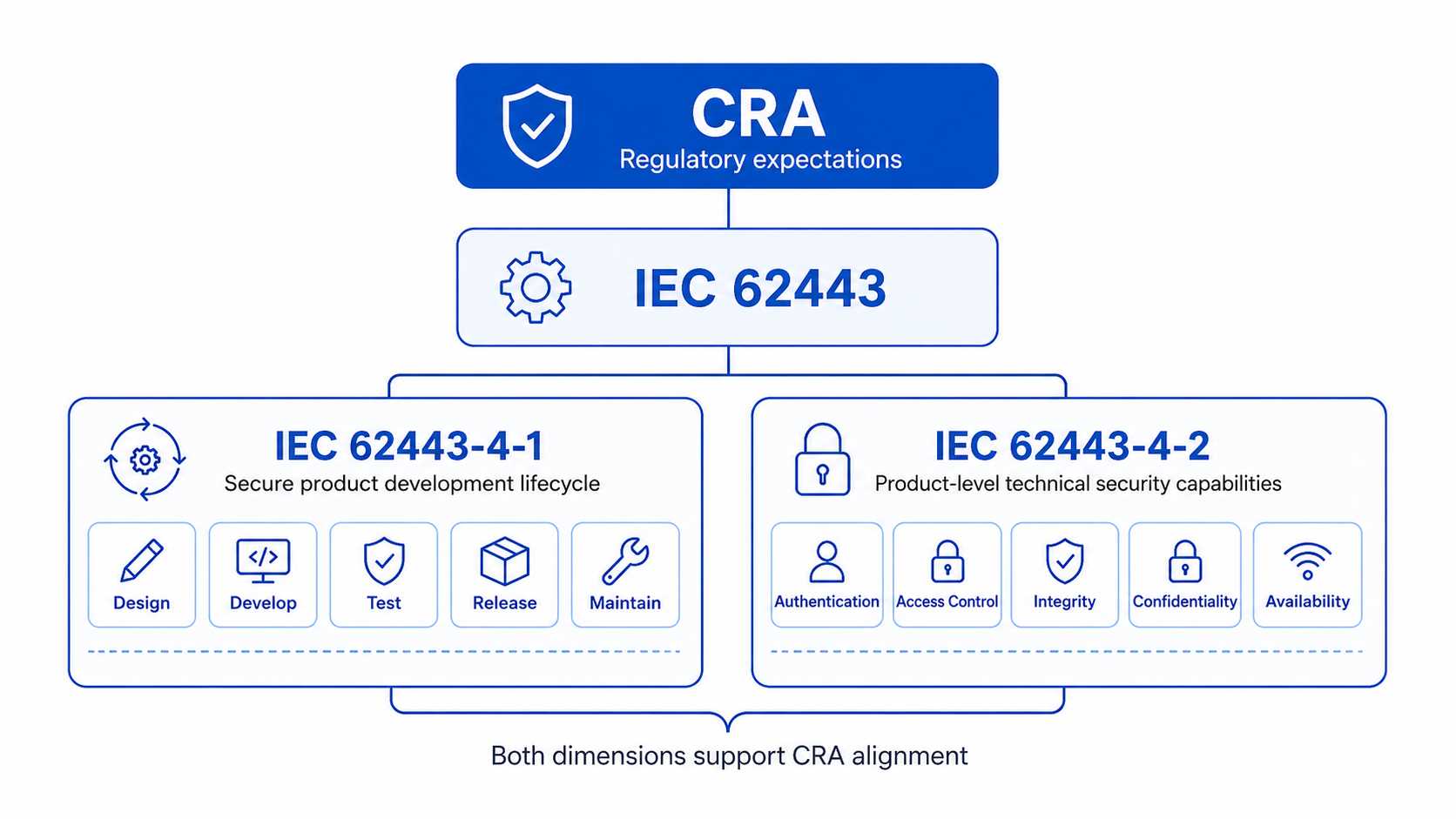
CRA sets the regulatory expectations. Standards help make those expectations easier to assess and implement in practice.
For industrial automation, internationally recognized cybersecurity standards are especially important because they help translate broad regulatory expectations into structured security practices.
IEC 62443 is highly relevant in this context because it was designed for industrial automation and control system environments. Rather than treating cybersecurity as a generic IT checklist, it addresses the realities of operational technology, including connected components, long product lifecycles, controlled updates, system availability, and supplier responsibility.
For Hai Robotics, IEC 62443 provides a practical foundation for preparing for CRA expectations.
IEC 62443-4-1 focuses on secure product development lifecycle practices. It helps demonstrate that products are designed, developed, tested, released, maintained, and retired through structured security processes.
IEC 62443-4-2 focuses on product-level technical security capabilities. It helps demonstrate that the product itself includes security capabilities suitable for connected industrial environments.
In simple terms, IEC 62443-4-1 is about how products are built securely. IEC 62443-4-2 is about what security capabilities the product provides. Both dimensions matter for CRA readiness.
Hai Robotics’ Progress Toward CRA Readiness
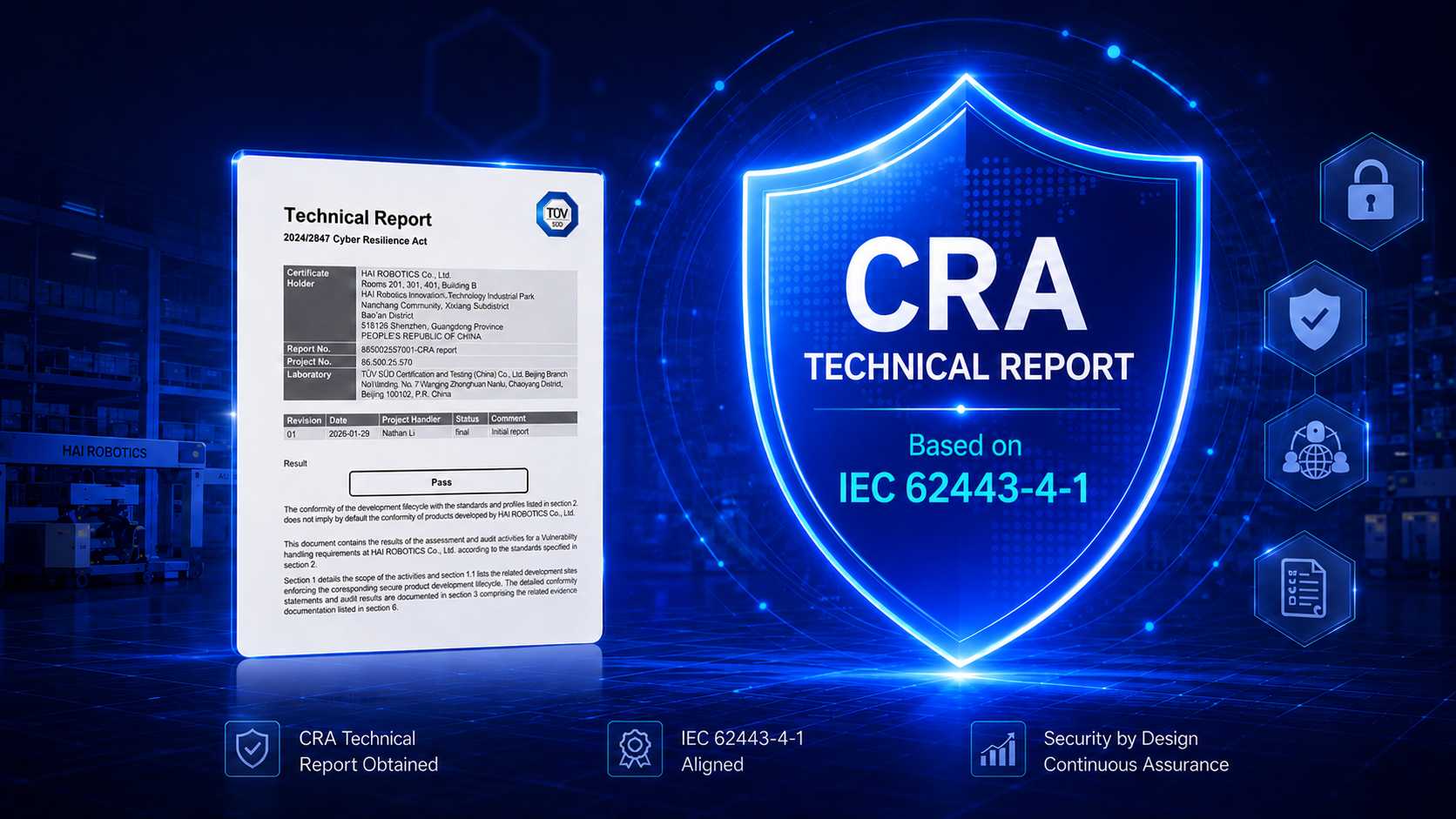
Hai Robotics has already achieved IEC 62443-4-1 certification, which validates secure product development lifecycle practices. This is an important foundation because CRA readiness begins long before a product reaches the market.
Hai Robotics has also completed a TÜV SÜD CRA Technical Report based on IEC 62443-4-1. This gives customers and partners additional third-party evidence that our cybersecurity work is being evaluated in relation to the evolving European regulatory environment.
The next step is product-level security capability. Hai Robotics is progressing toward IEC 62443-4-2 certification, which focuses on the technical security capabilities of industrial automation components.
Together, these efforts reflect a layered approach to cybersecurity readiness: secure development process, third-party CRA-related technical evaluation, and product-level cybersecurity capability.
This is the direction customers should expect from automation suppliers as CRA becomes part of the European market landscape.
From Compliance Pressure to Customer Confidence
For customers, the value of CRA readiness is practical.
It can support smoother supplier assessment because security processes and documentation are easier to review. It can help integrators and partners work with clearer product-level evidence. It can reduce late-stage compliance uncertainty in EU projects. It can also support better lifecycle planning by clarifying how vulnerabilities, updates, and support responsibilities are managed after deployment.
Most importantly, it helps protect the long-term value of automation investment.
Warehouse automation is not purchased for a single year. Customers expect systems to perform reliably across changing business needs, software environments, integration requirements, and regulatory expectations. Cybersecurity readiness is becoming part of that long-term performance promise.
The Cyber Resilience Act is raising the baseline for connected products in Europe. But for warehouse automation customers, the bigger message is simple: cybersecurity can no longer rely on broad promises alone.
It needs evidence.
It needs lifecycle responsibility.
It needs suppliers who are preparing before the deadline arrives.
At Hai Robotics, we see CRA readiness not only as a compliance requirement, but as part of building customer confidence in connected automation. By aligning our development processes, technical security capabilities, and third-party evaluation with recognized industrial cybersecurity standards, we aim to help customers deploy warehouse automation systems that are ready for both operational demands and regulatory expectations.
The future of warehouse automation will be connected. It should also be demonstrably secure.