


Inside HaiPick Climb: From System Design to Real-World Fulfillment
How a modular approach to storage, robotics and software helps warehouses improve fulfillment performance and prepare for growth.
More inventory. Faster fulfillment. Limited floor space. Warehouses face these pressures together, and solving one without addressing the others can simply move a bottleneck elsewhere.
HaiPick Climb brings storage density, throughput and operational flexibility into a single goods-to-person Automated Storage and Retrieval System (AS/RS). Combining compact HaiClimber robots, high-density racking, configurable workstations and HaiQ software, it helps warehouses make better use of available space while moving inventory efficiently through the fulfillment process.
The design starts with a practical question: How can warehouses gain the performance of automated storage and retrieval while making the system easier to implement, operate, maintain and expand?
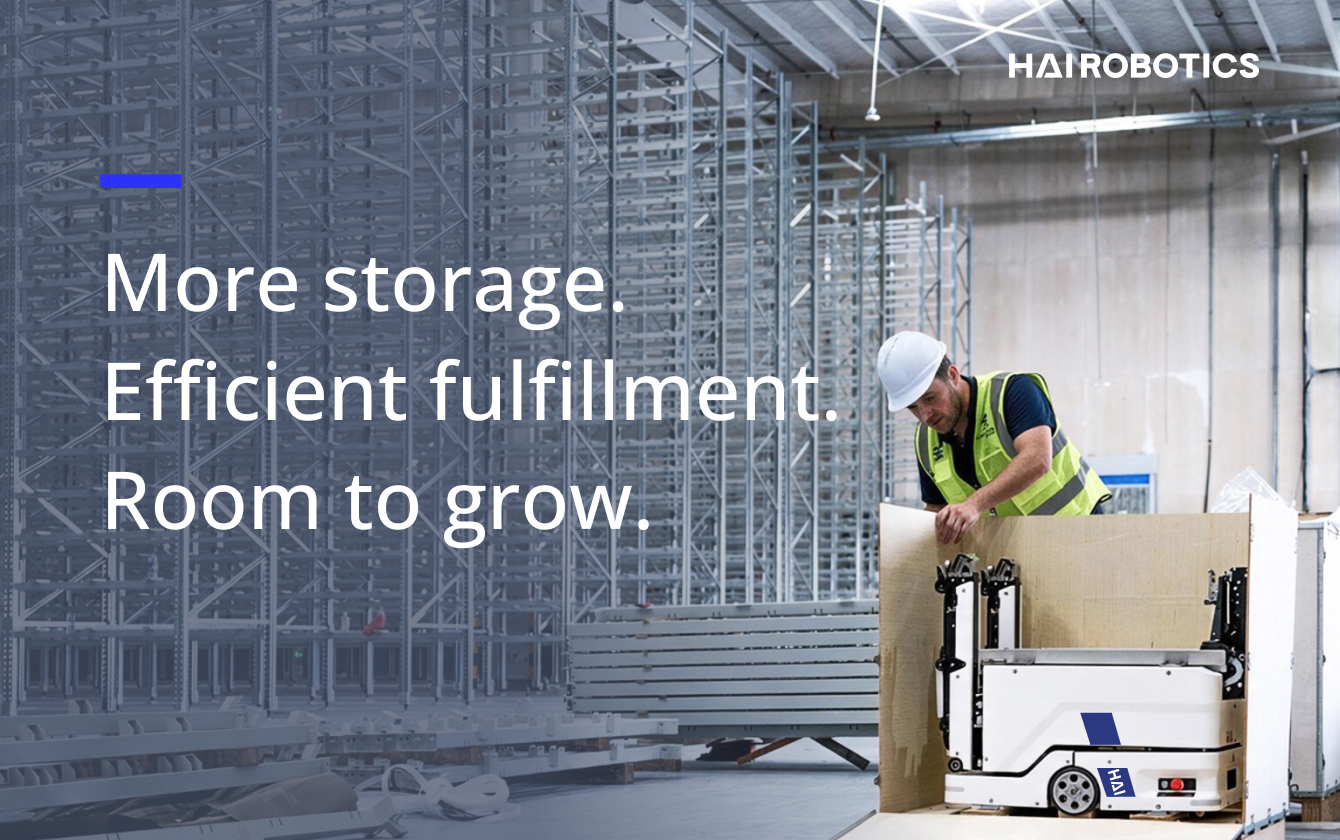
More Storage Within the Available Footprint
HaiClimber robots move independently beneath the racking, travel between aisles and climb vertically to retrieve inventory. Climbing channels attach to one side of industry-standard racking, reducing the facility preparation required compared with more infrastructure-intensive AS/RS designs.
The latest configuration supports double-deep storage and up to 45,000 totes within 1,000 square meters, or approximately 10,700 square feet. Within that footprint, the system can deliver totes to workstations in under two minutes and support throughput of up to 4,000 totes per hour.
These are system-level capabilities. Actual performance depends on the layout, workflows, inventory characteristics and order profile of each operation.
Packaging flexibility also helps customers accommodate different inventory requirements. HaiPick Climb supports multiple tote and tray formats, including workflows that handle cartons or products in their original packaging without manual decanting.
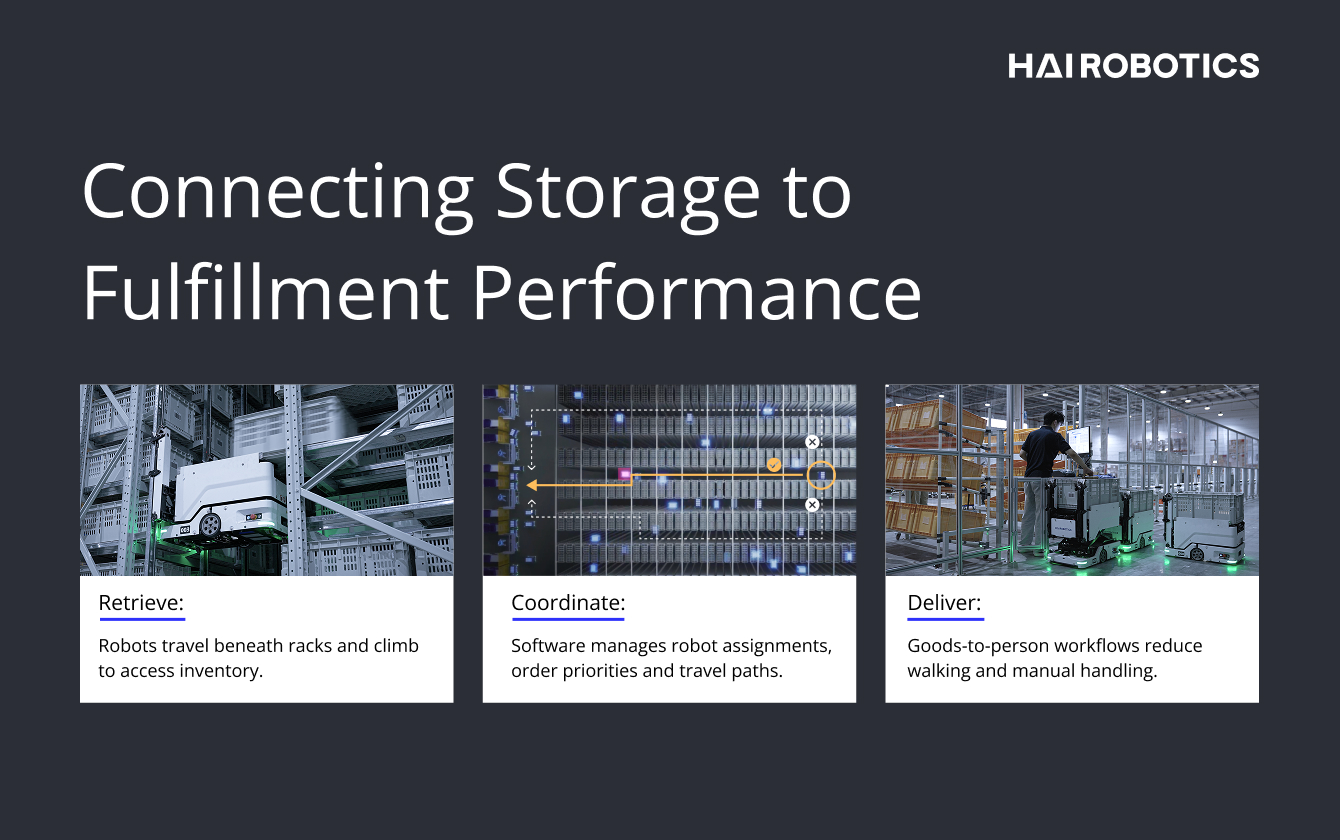
Connecting Storage to Fulfillment Performance
High-density storage creates value when inventory can move through the operation at the pace orders require.
HaiPick Climb brings inventory directly to ergonomic workstations, reducing the travel and manual handling associated with conventional picking. HaiQ software coordinates storage, order priorities, robot assignments and travel paths in real time to support material flow during daily operations and peak demand.
The system can support applications across e-commerce, apparel, retail, grocery, healthcare, automotive, manufacturing, consumer electronics and third-party logistics. Each application brings different requirements, making the relationship between storage, software, workstations and surrounding processes central to the design.
Customers can start with the robots, racks and workstations needed for their current operation, then add resources as volumes, SKU counts or fulfillment requirements change. This modular approach supports phased investment and expansion without requiring a complete system redesign.
Implementation Starts With Understanding the Operation
Every project begins with the customer’s operational requirements. Hai Robotics and its integration partners evaluate inventory characteristics, SKU movement, order profiles, inbound and outbound workflows, throughput targets, facility constraints and growth expectations.
That information determines the layout, robot and workstation requirements, software integration scope and how the system will fit into existing processes.
HaiPick Climb’s compact robots, industry-standard cross-bar racking and minimal fixed conveyance help reduce facility preparation. The architecture can also accommodate more floor variation than many traditional AS/RS designs, supporting both new facilities and brownfield retrofits.
After the infrastructure, workstations and charging equipment are installed, HaiQ software is configured and integrated with the customer’s warehouse management or enterprise systems. Commissioning and testing validate the complete system against agreed workflows and performance requirements.
Operator and maintenance training, user acceptance testing, go-live planning and post-launch support are incorporated into implementation. Project schedules depend on system size, facility readiness, integration scope and operational complexity.
What Performance Looks Like at Scale
A large HaiPick Climb installation supporting a cross-border e-commerce fulfillment operation in the United States illustrates how the architecture performs across a complete facility.
The installation includes:
-
323 HaiClimber robots
-
452,448 storage locations
-
Approximately 44 tote locations per square meter
-
Outbound throughput of 8,265 totes per hour across the complete installation
-
Picking accuracy above 99%
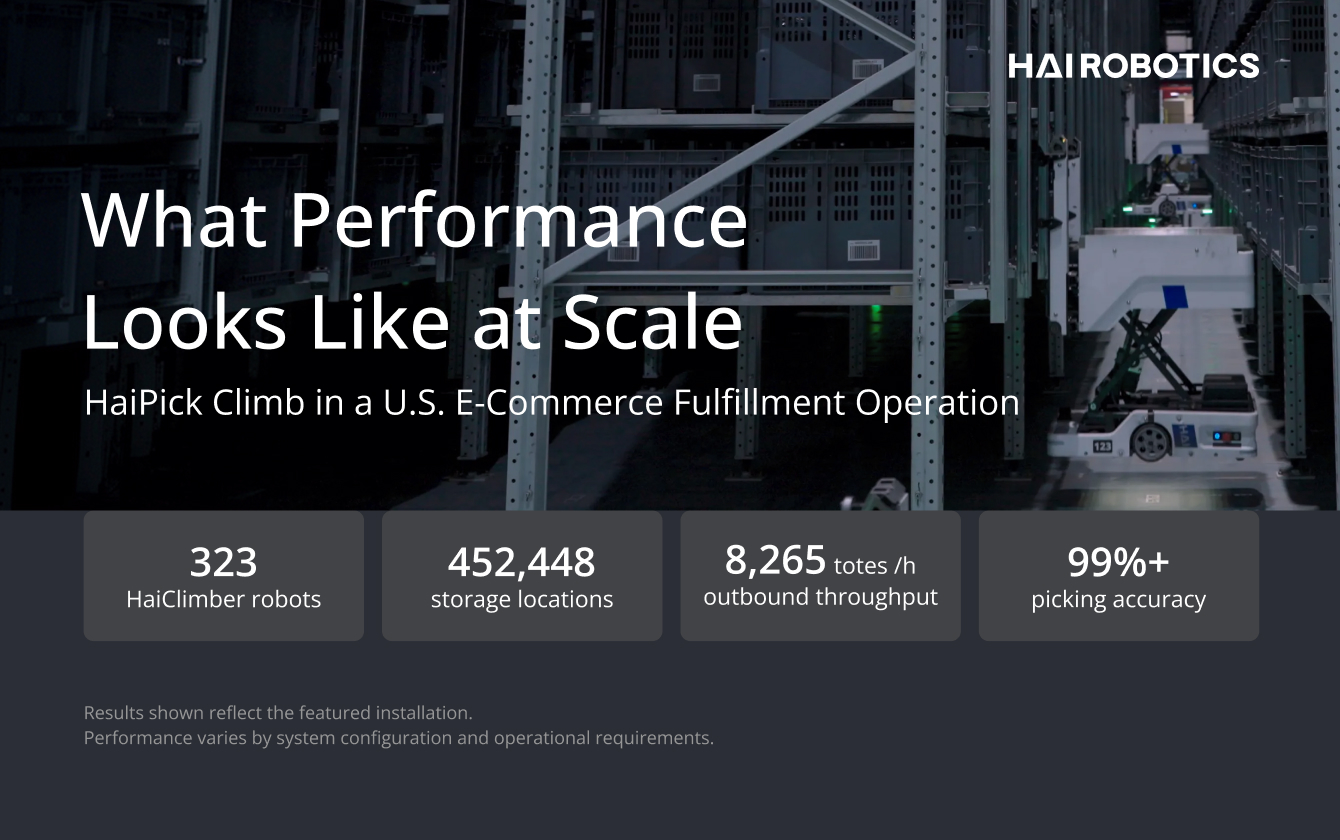
The operation required substantial storage capacity and outbound throughput while maintaining accuracy across a large, diverse inventory.
Its results demonstrate the importance of coordinating robots, software, racking, workstations and material flow. The value comes from translating the scale of the installation into usable storage, sustained throughput and accurate fulfillment.
Since HaiPick Climb’s global introduction in 2025, more than 10,000 HaiClimber robots have been contracted for projects in 12 countries. Eight customers have expanded an existing system or selected the solution again for another project.
Learn more about HaiPick Climb capabilities and real world case studies.
Support Beyond Go-Live
For U.S. customers, Hai Robotics combines global product experience with teams and resources based in the United States. Its Americas headquarters and support operations in Alpharetta, Georgia, provide a base for solution engineering, project delivery, software support, training, customer service and spare-parts distribution.
After deployment, support includes remote system assistance, preventive maintenance, spare parts and on-site service when required. Integration and solution partners across the Americas provide additional engineering, installation and service capabilities.
The objective extends beyond commissioning equipment. A successful automation investment must help the customer achieve the throughput, accuracy, labor and service goals behind the business case—and continue meeting those goals as the operation evolves.
Planning your next stage of warehouse automation? Connect with Hai Robotics to explore how HaiPick Climb can support your storage and fulfillment requirements.