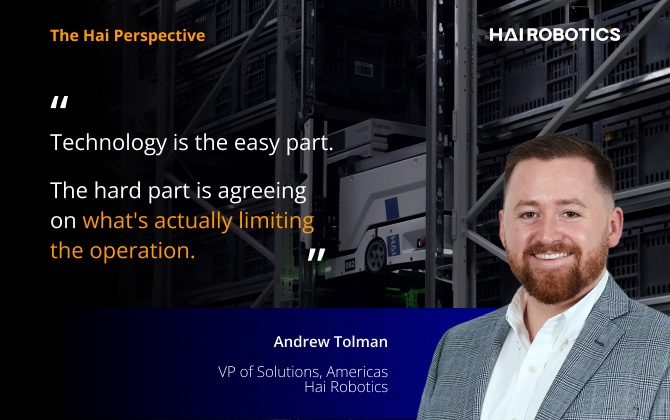
It’s why Andrew resists ranking automation technologies against each other in the abstract. A fixed system can be highly efficient when volume and mix are stable. Modular robotics can make more sense when capacity needs to be added in stages, or the building is likely to change. A manual or hybrid process can still be the right call when volume hasn’t matured or the process still needs to be proven. “I would choose the option that fits the business case, product profile, building, and growth plan, and that the site can support after the project team leaves.”
START WITH THE BUSINESS OUTCOME, NOT THE TECHNOLOGY
If the conversation shouldn’t start with robots, where should it start? With business goals: reducing fulfillment cost, increasing storage density, improving delivery performance, or supporting future growth. Only once success is defined can the right automation fit be determined.
In practice, that means Andrew opens with requirements, not products: volume, SKU and mode mix, cutoff and service windows, where the current process fails, and what happens to the business if nothing changes. From there he moves into the building, the labor model, the systems, and the growth assumptions. He also makes a point of asking site leaders what makes the process hard to run today. “Their answer is often more useful than the high-level project description.”
On KPIs, his advice is restraint rather than volume. Rather than a scorecard of twenty measures, he picks the few tied directly to the reason for the investment: on-time shipping, cutoff attainment, sustainable throughput at the actual mix, accuracy, labor per unit, storage capacity, system availability, recovery time, and cost per order or case, with safety and ergonomics built in from the start, not added later. A throughput number without the mix, duration, and service window attached, he notes, doesn’t tell you much.
Starting with the objective can change the recommendation entirely. A missed cutoff might be solved largely by slotting or order-release logic. A building with no room to grow might need storage density above all else. A process still in flux might call for a manual or semi-automated first phase rather than a full design commitment. Andrew has seen this play out directly on deployments where the team launched manually in some cases to validate SKU flow, labor, replenishment, and WMS rules before committing more capital, generating real operating data and reducing the risk of scaling the wrong design.
A LESSON FROM EXPERIENCE
Andrew’s perspective is shaped as much by years spent designing these systems from the solutions side as by his current role guiding customers through them. One of the clearest examples came early in his career, on a project built to support a better replenishment model for a retailer’s constrained urban stores. The team started manually, with a WMS-driven operation, to understand single-piece handling, sequencing, milk runs, and staffing before adding technology. That launch reduced out-of-stocks by more than 50 percent and reached 98 percent operational readiness within 30 days.
A robotic concept came next. The technology worked, but cycle time became the constraint, and it couldn’t scale to the volume the business needed, so the design changed. “A concept can be technically impressive and still be the wrong answer for the operation. You have to be willing to change it when the data says it will not scale.”
That experience still shapes how Andrew advises customers today. “The customer lives with every design decision we make. A demo is controlled. A real site has wrong product dimensions, late inventory, blocked paths, system delays, staffing gaps, maintenance issues, and a peak mix that does not behave like the average.” He now spends far more time on those conditions up front: clear exception paths, recovery procedures, rollback criteria, spares, training, and ownership before go-live. He also favors a controlled ramp, increasing volume when the process is stable rather than when the calendar says it’s time.
The broader lesson: a capital approval is only the beginning. It also commits a company to integration, data cleanup, training, maintenance, site leadership, and a stabilization period. Treat those as secondary work, Andrew says, and the expected value tends to arrive later than planned. He also encourages customers to ask, up front, how the solution will be supported after the project team leaves, and how benefits will be measured six or twelve months later. Mechanical acceptance confirms the equipment was installed. It says nothing about whether the operation is delivering the business case.
WHAT WILL SEPARATE WINNERS FROM EVERYONE ELSE
There is no universal “best” automation solution, only the solution that fits a company’s specific operational challenge and business objectives. The companies that get the most out of automation, in Andrew’s experience, aren’t chasing the newest technology. They’re asking better questions from the outset.
If warehouse leaders remember one thing, Andrew wants it to be this: look first at what’s leaving the building. Are the right orders shipping on time, at the right cost and accuracy? Can the team run the operation and recover when something goes wrong?