How Omnichannel Fulfillment Challenges Are Addressed in Fashion and Footwear
Discover how fashion and footwear brands can build scalable, omnichannel-ready warehouses with connected inventory, flexible fulfillment, and adaptive operations. Learn how Hai Robotics enables efficient, resilient logistics systems for long-term growth.
Walk into any fashion brand today and you will hear the same challenge. Sales are growing. Channels are expanding. But operations are becoming harder to manage.
A customer might browse online, try in-store, and expect next-day delivery at home. Another might order online and return in-store. At the same time, stores still rely on frequent replenishment, while marketplaces push for ever shorter delivery windows.
This is the reality of omnichannel retail today, where customer expectations are no longer tied to a single channel.
It is not just about adding more channels. It is about fulfilling all of them, at the same time, from the same inventory, with speed and accuracy. And this is exactly where traditional apparel warehouse operations begin to fall behind.
From Fragmented Inventory to One Shared Stock Pool
Why traditional inventory models are no longer enough
Most fashion and footwear supply chains were not originally designed for omnichannel.
Inventory is often split across different locations and systems, leading to:
-
Stock sitting idle in one channel while unavailable in another
-
Delayed or inaccurate inventory visibility
-
Excess safety stock and reduced turnover
-
Inefficient use of space and labor
At its core, the issue is not inventory shortage. It is fragmentation.
Moving toward a unified inventory model
Hai Robotics approaches this challenge by introducing a more flexible, goods-to-person automation model, such as HaiPick Systems, to fundamentally change how inventory is stored and managed.
Instead of organizing stock by channel or location, the system enables brands to treat inventory as a shared resource across the entire operation. This shift is important because it removes the need to “guess” where inventory should sit in advance, and instead allows it to be allocated dynamically based on real demand.
In practice, this creates a unified inventory pool where:
-
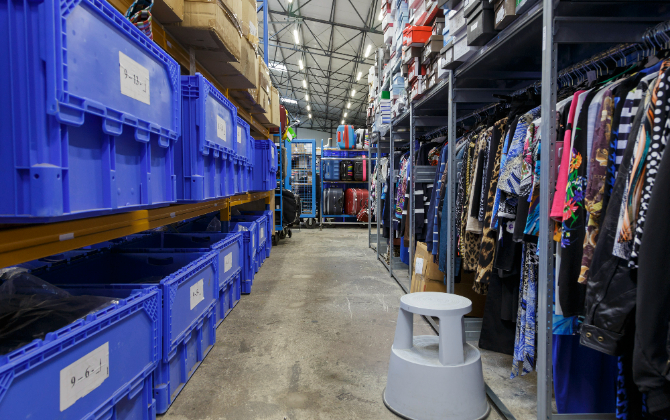
Inventory from stores, e-commerce, and returns is consolidated into one system, eliminating channel-based silos
-
A wide range of inbound scenarios are supported, including new product launches, daily replenishment, store returns, and e-commerce returns
-
Different product categories such as apparel, footwear, and accessories can be stored together while maintaining efficient access
Because inventory is no longer fragmented, it also becomes significantly easier to manage and act upon.
Turning visibility into operational decisions
Operations teams gain:
-
Real-time visibility across all SKUs and storage locations
-
The ability to identify stock-out risks or excess inventory earlier
-
Full traceability of inventory movements from inbound to outbound
The impact of this shift is not just better visibility, but better decision-making.
When inventory is shared and transparent, brands can reduce unnecessary safety stock, improve allocation across channels, and respond faster to changing demand patterns.
Real-world impact
In large-scale operations, this shift becomes even more impactful when inventory fragmentation is eliminated at the facility level.
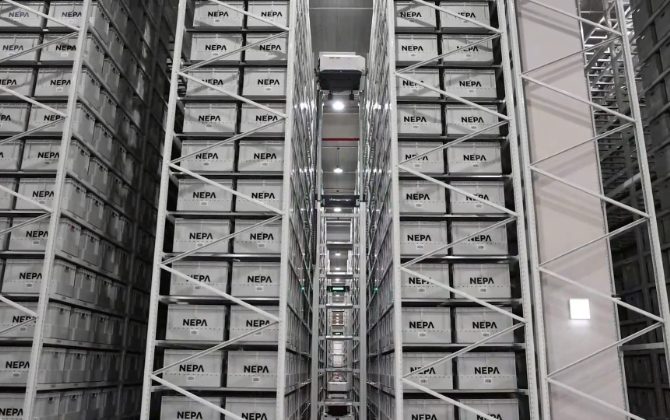
At NEPA, a fashion brand in South Korea, separate warehouses were consolidated into a single integrated distribution center, allowing all inventory to be managed as one shared pool. This not only improved inventory utilization and allocation across channels, but also significantly increased storage capacity, supporting up to 2.9 million items within one facility. This allows inventory to be allocated more efficiently across channels without increasing overall stock levels.
Returns also become part of this unified flow. Instead of being treated as a separate process, they are quickly reintegrated into available inventory, improving sell-through and reducing waste. If you would like to explore this further, you can read more here:
Turning Apparel Returns Bottlenecks into Smoother Operations
Once inventory is unified, the next question becomes unavoidable. How do you fulfill very different types of orders from the same pool, without creating new bottlenecks?
One Warehouse, Multiple Fulfillment Flows
Why omnichannel complexity is about variation, not volume
Omnichannel complexity in fashion logistics is not just about handling more orders. It is about handling very different types of orders, all within the same operation.
As brands expand across channels, a single warehouse is often expected to support multiple fulfillment scenarios at once:
-
B2B store replenishment Typically involves large order volumes with concentrated SKUs. These orders are often case-based and require efficient batch handling to ensure stores can replenish quickly and keep shelves stocked
-
B2C e-commerce orders Much smaller and more fragmented, often with multiple SKUs per order. This requires piece picking and frequent switching between locations, which can quickly reduce efficiency in a manual setup
-
Time-sensitive orders Orders with strict service level requirements, such as same-day delivery or JIT fulfillment, where delays directly impact customer experience and platform performance
-
Returns processing A constant flow in fashion logistics, especially after promotions. Returned items need to be inspected, sorted, and quickly reintegrated into sellable inventory to avoid value loss
Each of these flows operates differently. When they are forced into a single rigid process, the result is often congestion, delays, and increasing operational cost. Some brands attempt to solve this by splitting operations across multiple warehouses, but this introduces new challenges such as inventory duplication and longer fulfillment lead times.
Enabling multiple flows in one system
A more effective approach is to allow these different flows to coexist within one system, while still being handled in the most appropriate way.
This is where HaiPick Systems changes how fulfillment is executed. Instead of relying on fixed processes, the system continuously adapts to the nature of each order. In practice:
-
Orders are automatically identified and prioritized based on type, urgency, and fulfillment requirements
-
The system dynamically applies the most suitable picking method, whether it is batch picking for small orders or more consolidated handling for larger ones
-
Different workflows can run at the same time without competing for the same resources
At the same time, the physical operation is designed to support this flexibility:
-
Workstations, like the Auto Tray & Detray Workstations, can be configured to handle full-case operations more efficiently, supporting high-volume B2B flows.
-
Other workstations, such as the 1-to-1 High Performance Workstation, are designed for high-frequency, single-order processing. This fits well with fragmented B2C e-commerce orders, where frequent SKU switching and small order sizes require fast, accurate, and highly responsive picking to maintain throughput and reduce error rates.
-
Integrated workflows allow picking, packing, and verification to happen in a single flow, reducing handling time and errors.
The result is not just higher efficiency, but a more stable operation as complexity increases.
Real-world impact
In practice, this ability to handle different order types with tailored execution strategies is critical.
At ANTA’s distribution center, different workstation configurations are designed specifically for B2B and B2C flows. For store replenishment, flow rack workstations are used to handle footwear orders by consolidating the same style and SKU, enabling batch picking and improving store receiving and put-away efficiency.
For e-commerce orders, piece-picking workstations are optimized for small, multi-SKU orders, supporting fast and accurate processing of fragmented demand. As a result, overall picking efficiency doubled compared to the previous manual operation.
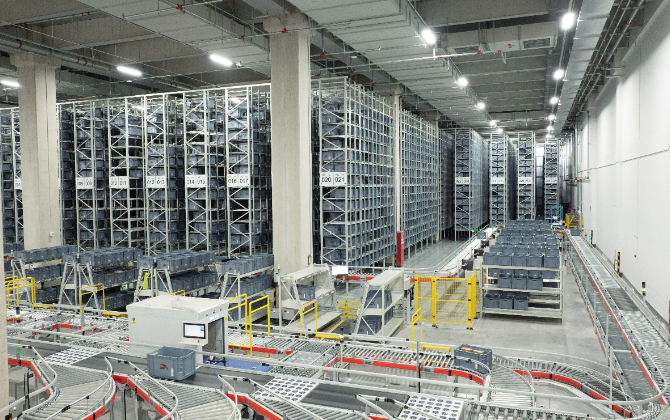
This setup allows both flows to run simultaneously without interference, achieving daily throughput of up to 350,000 items for B2B orders and 53,000 items for B2C fulfillment.
As fulfillment becomes more streamlined, another challenge becomes more visible.
How do you maintain efficiency when demand is constantly changing throughout the day, the week, and the season?
Built for Peaks, Returns, and Constant Change
The nature of demand volatility in fashion logistics
Fashion logistics is inherently dynamic, and this is often where operations feel the most pressure.
Demand does not grow in a straight line. It fluctuates constantly, driven by promotions, product launches, and seasonal cycles. At the same time, different types of workloads overlap and compete for the same resources.
In a typical omnichannel environment, warehouses need to deal with:
-
Sudden outbound peaks Promotions and campaign periods can multiply order volumes within hours, putting immediate pressure on picking, packing, and shipping capacity
-
Post-peak return waves After sales events, large volumes of returns flow back into the warehouse, requiring inspection and reprocessing while outbound operations are still ongoing
-
Shifting channel demand The balance between B2B replenishment and B2C fulfillment can change frequently, even within the same day, making resource planning difficult
Without built-in flexibility, these fluctuations quickly translate into operational inefficiencies:
-
Peak periods create congestion and delays across picking and packing processes
-
Off-peak periods leave labor and equipment underutilized
-
Teams rely heavily on manual coordination to rebalance workloads, increasing complexity and cost
Rather than reacting to these changes after they happen, HaiPick Systems focuses on building adaptability directly into the system.
This starts with how work is planned and released.
More adaptive workload orchestration
-
Orders are grouped and released based on real-time priorities, deadlines, and order characteristics, rather than fixed schedules
-
Workloads are continuously balanced across available workstations, reducing bottlenecks before they form
-
Urgent or high-priority orders can be inserted into ongoing operations without disrupting the overall flow
At the same time, flexibility is reinforced at the execution level through goods-to-person robotics.
Flexible execution with goods-to-person automation
-
During peak periods, more system capacity is directed toward outbound fulfillment, helping absorb spikes in demand
-
During quieter periods, the same resources are automatically reallocated to replenishment, slotting optimization, and inventory consolidation
-
Fast-moving SKUs are dynamically positioned closer to workstations, reducing travel time and improving picking efficiency
-
Idle time is used productively to reorganize inventory, making future operations faster and more efficient
This combination allows the warehouse to continuously adjust to changing conditions, rather than falling behind and trying to catch up.
Real-world impact
This level of adaptability becomes critical when demand fluctuates across channels and time.
At ITOCHU Logistics' warehouse, the operation handles fast fashion products, where seasonal peaks, return waves, and shifting demand between B2B and B2C often happen simultaneously. Instead of following a fixed process, workloads are balanced dynamically. Outbound tasks are prioritized during peak windows, while returns and replenishment are shifted to off-peak periods to avoid congestion.
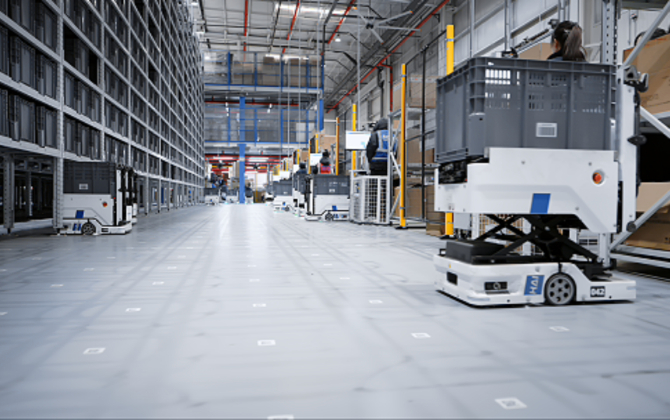
Robot capacity is also reallocated based on demand, focusing on picking during spikes and switching to replenishment and consolidation when volumes stabilize.
This allows the warehouse to absorb fluctuations without disruption, maintaining stable throughput of over 3,000 totes per hour while keeping inventory flowing back into available stock.
Building a Warehouse That Supports Growth
Omnichannel is not a short-term shift. It is a long-term transformation in how fashion and footwear brands operate.
To keep up, warehouses need to evolve into systems that are:
-
Connected Inventory is shared and visible across all channels
-
Flexible Multiple order types can be handled at the same time
-
Adaptive Operations respond dynamically to demand changes
Hai Robotics enables this transformation by combining automation, intelligent software, and flexible system design into a solution that works in real operational environments.
Ready to Take the Next Step
Omnichannel growth does not have to mean operational complexity.
If you are looking to improve inventory utilization, increase fulfillment efficiency, and build a more resilient warehouse operation, we can help.
Get in touch with our team to explore how leading fashion and footwear brands are transforming their logistics operations for the future.