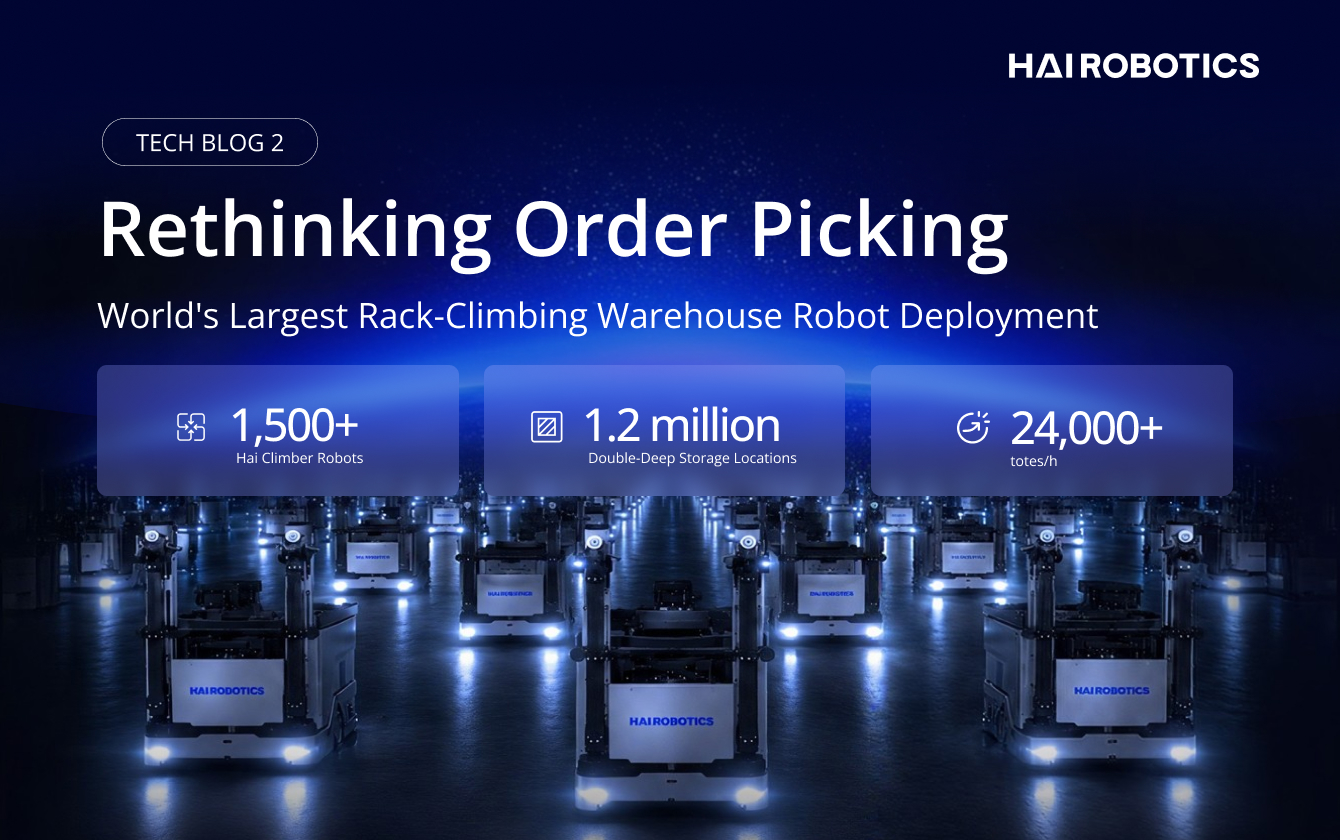
Tech Blog 2 — Rethinking Discrete Order Picking for High-Throughput E-commerce Fulfillment
In high-volume e-commerce fulfillment, choosing the right picking strategy has always been a balance of performance, cost, and process complexity.
Two common approaches are batch picking, where items for multiple customer orders are picked together, and discrete order picking, where orders are picked individually, directly into their designated order containers. As automation technology has evolved, the balance between these two approaches has shifted.
In earlier manual and semi-automated operations, batching helped reduce picker travel. As goods-to-person automation evolved, the same logic shifted toward reducing repeated inventory presentations.
This made batch picking particularly attractive in high-throughput environments. By aggregating demand across multiple orders, one source-tote presentation can serve several order lines, making each movement more productive. This is often reflected in a higher picking hit rate — more useful picks completed from each source tote.
The Trade-off Behind Batch Picking
But the efficiency gained upstream does not eliminate order-level work.
When items for multiple customer orders are picked together, they still need to be separated into their final order destinations. Depending on the operation, this can introduce additional sorting, buffering, sequencing, consolidation, and intermediate handling downstream.
Batch-based flows also create stronger dependencies between picking, wave planning, buffering, and downstream sortation. This can make the overall process harder to adapt when order profiles, SKU mix, or throughput requirements change.
Batch picking therefore creates a clear trade-off:
fewer source-tote movements upstream, in exchange for more downstream processing.
That trade-off makes sense when the savings in inventory movement — and the performance gained through batching — outweigh the additional equipment, space, labor, and process complexity required downstream.
It also explains why discrete order picking has historically been difficult to scale in demanding e-commerce operations. If the automation system cannot move inventory fast enough, serving orders individually may require too many tote movements to achieve the required throughput economically.
In other words, the preferred picking strategy has never been determined by process logic alone. It has also been constrained by what the available automation technology could deliver.
As technology evolves, that constraint can change.
When Technology Makes Discrete Picking Viable at Scale
Earlier generations of tote-handling AMRs made inventory movement more flexible and cost-effective, but their performance still favored batch-based flows in demanding fashion and e-commerce applications. Higher-throughput systems improved this balance, yet in very large operations, batch picking and downstream sortation often remained necessary to reach the required performance level.
Rack-climbing AMRs push that boundary further. By combining direct inventory access, high-density storage and higher tote-handling performance, HPC makes discrete order picking viable at a throughput level that earlier AMR architectures could not support.
This reduces the need to pick in bulk and later reconstruct individual customer orders through additional sorting and consolidation, removing substantial downstream complexity, labor, and time.
Rather than optimizing primarily around the productivity of each tote presentation, fulfillment design can increasingly look at the entire order journey - from inventory retrieval to picking, sorting, consolidation, and dispatch.
What This Means in Fashion E-Commerce
The economics become particularly interesting in high-SKU, high-return e-commerce operations.
Batch picking delivers the greatest benefit when multiple orders share the same inventory. But when demand is distributed across a broad assortment and individual customer orders contain relatively few lines, aggregating more orders does not necessarily create a proportional increase in SKU overlap.
Meanwhile, the downstream requirements remain.
This is exactly why in the project we designed for a LPP Logistics, HaiPick Climb combined with discrete order picking proved to be the better fit for the customer’s fulfillment model. It optimizes the order journey in several ways.
-
Simpler fulfillment flow Items are picked directly into order-specific destinations, removing the rebinning and downstream picking sortation required in a batch-based flow. Fewer intermediate steps also simplify exception handling and day-to-day operations.
-
Higher space efficiency Eliminating dedicated batch accumulation, rebinning, and sortation areas reduces the footprint consumed by downstream processing, allowing more of the warehouse to be used for storage and productive operations.
-
Faster path to dispatch Orders can move from picking to shipping with fewer intermediate processing stages. With mobile put carts, orders for the same carrier can already be grouped together and transferred directly to outbound roll cages, simplifying shipping sortation and shortening the time from pick to dispatch.
For fashion e-commerce, this is where HaiPick Climb and discrete order picking can create a structural advantage: not by maximizing picking efficiency alone, but by simplifying the entire path from storage to shipment.
Look Beyond Picking Efficiency
There is no universally superior picking strategy. The right choice depends on three factors working together:
Technology capability — Can the system deliver the required throughput with the chosen picking method?
End-to-end cost — Does the reduction in upstream movement justify the additional equipment, labor, space, and handling required downstream?
Operational complexity — How much sorting, buffering, wave management, and process dependency does the flow introduce?
This is where automation architecture matters. As the cost of accessing and moving inventory changes, so does the balance between upstream efficiency and downstream complexity.
The goal, however, is not to choose one picking method universally. It is to design a fulfillment flow around the customer's specific operational needs and business objectives, finding the right balance between throughput, labor, investment, and system utilization.
Want to learn more about this landmark project? Join our webinar on 19 November. Alexander Peschel - EMEA Director, Solutions Consulting and Tomasz Wiącek - Country Manager CEE at Hai Robotics will explore how high-performance warehouse automation is reshaping order picking strategies for e-commerce fulfillment.