Why Omnichannel Apparel Fulfillment Is Breaking Traditional Warehouse Models
Omnichannel apparel fulfillment is reshaping warehouse operations. Learn why traditional warehouse models are failing and how growing complexity, SKU proliferation, and returns are driving a new operational reality.
What is omnichannel apparel fulfillment?
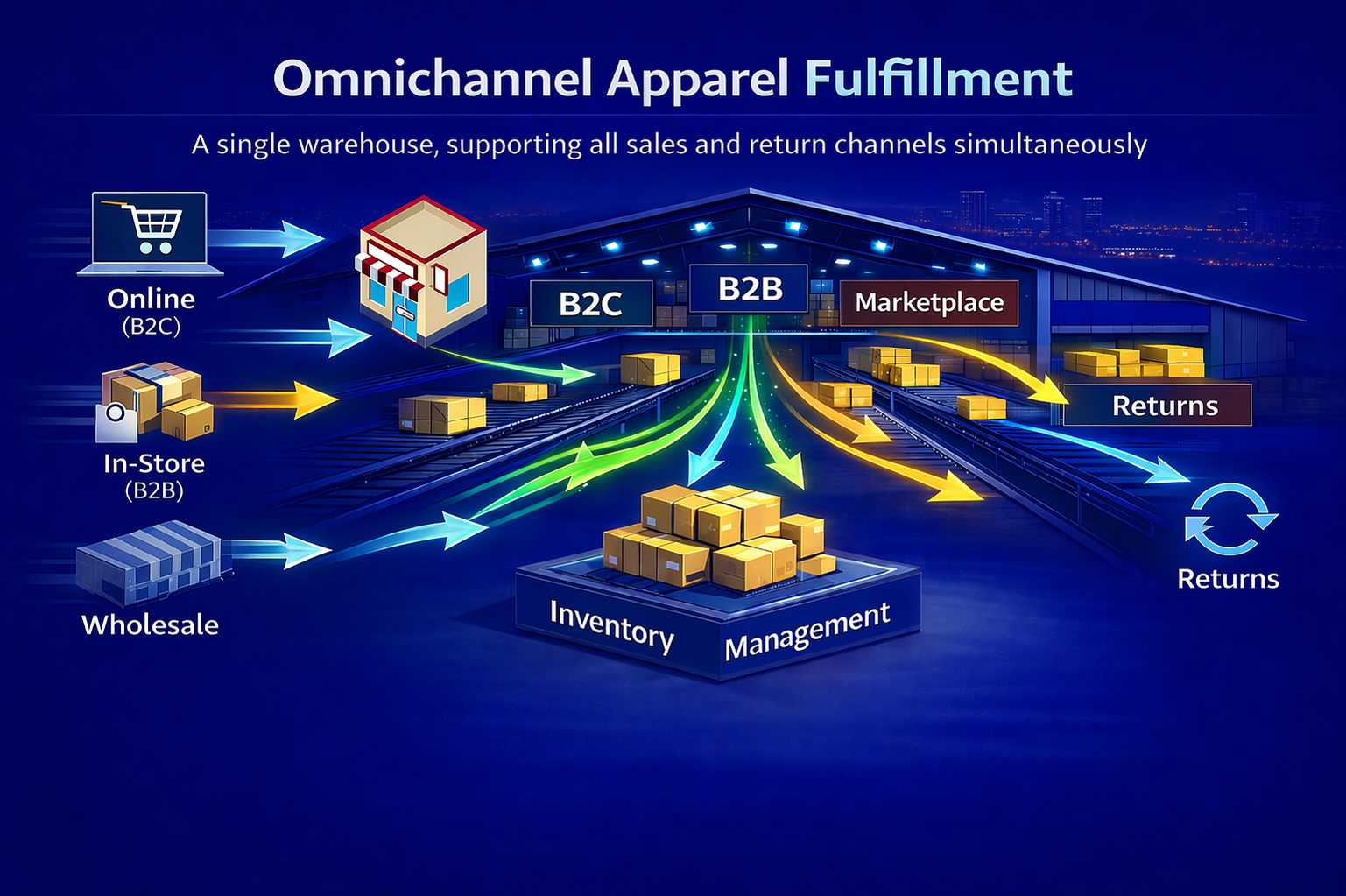
Omnichannel apparel fulfillment refers to a warehouse operating model where a single facility supports multiple sales and return channels simultaneously, including direct-to-consumer e-commerce (B2C), retail store replenishment (B2B), wholesale distribution, marketplace fulfillment, and reverse logistics — all drawing from a shared inventory pool. This approach to omnichannel order fulfillment requires unified inventory management across all channels rather than siloed allocation.
In traditional supply chains, these channels were typically managed in isolation. Inventory would be allocated in advance based on forecasts, workflows were designed around specific order types, and warehouse processes followed stable, repeatable patterns that could be continuously optimized for efficiency.
Omnichannel fundamentally changes this logic. Instead of planning for relatively predictable flows, warehouses must now operate as integrated systems that continuously respond to real-time demand signals with enhanced inventory visibility. Inventory is no longer fixed to a specific channel, order types are no longer processed in isolation, and operational priorities can shift throughout the day.
Key takeaway: Omnichannel is no longer just a retail or customer experience strategy. It represents a fundamental shift in how warehouse systems must be designed and operated.
The moment warehouses stopped being predictable
For decades, apparel warehouses were built around a relatively stable operational environment. Demand could be forecasted using historical data and seasonal trends, order structures remained consistent, and workflows could be designed for efficiency and repetition. Traditional warehouse management system implementations focused on optimizing these predictable patterns. In this context, optimization meant reducing movement, improving throughput, and standardizing processes across the operation.
This approach worked because the system itself was predictable.
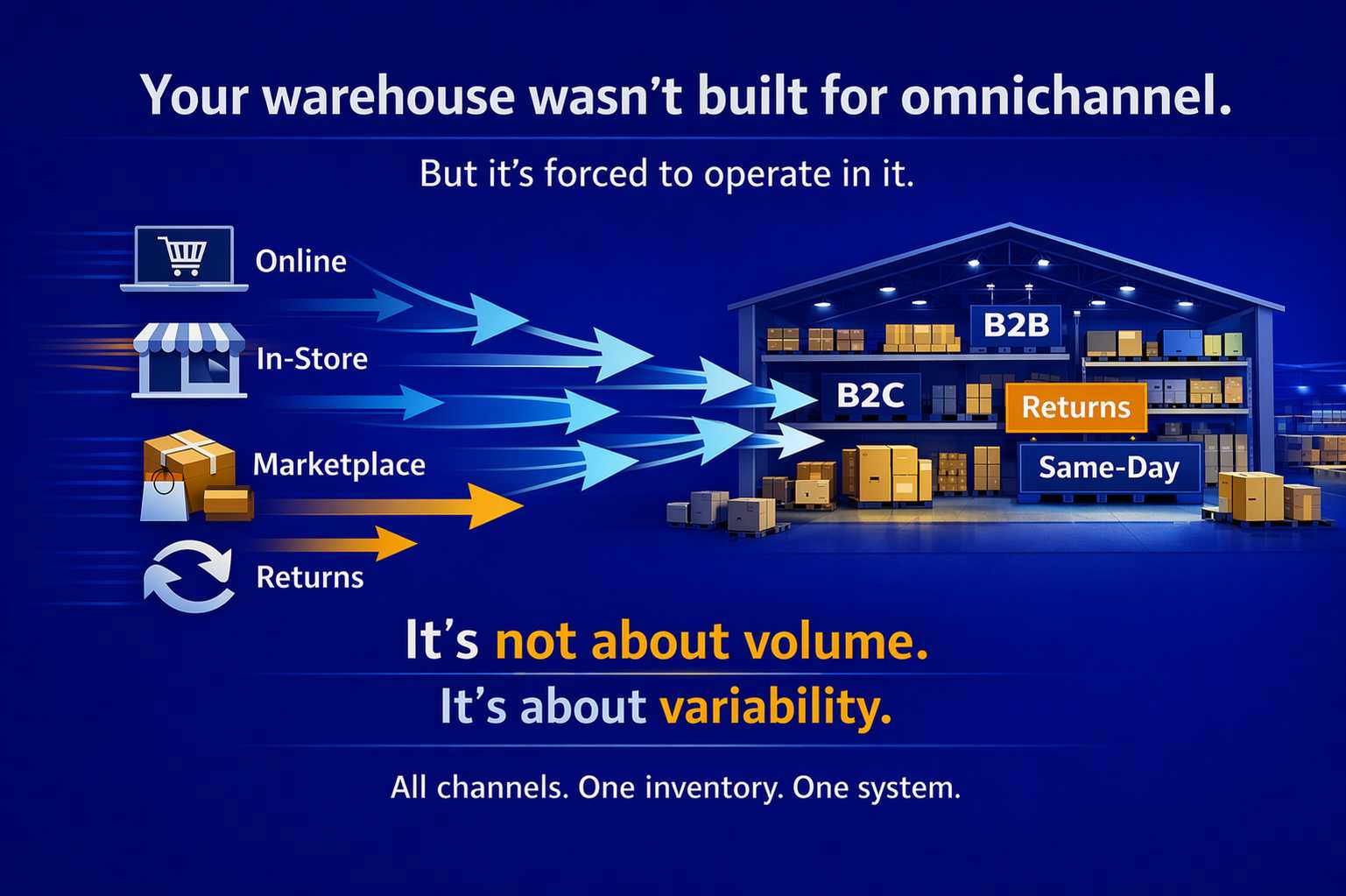
However, in today's omnichannel retail environment, that predictability has largely disappeared. Customer behavior no longer follows a linear path, and interactions with brands span multiple touchpoints. A single order journey may involve online browsing, in-store availability checks, marketplace purchases, and cross-channel returns.
Each of these interactions generates operational consequences, and all of them converge inside the warehouse. What used to be separate, manageable flows are now interconnected and interdependent, requiring real-time inventory tracking and supply chain integration across all touchpoints.
Authoritative insight: Omnichannel fulfillment does not simply increase operational workload — it fundamentally changes how warehouse systems behave.
Warehouses are no longer executing predefined plans based on stable forecasts. Instead, they are continuously responding to shifting demand patterns, often in real time and under competing priorities.
The real shift isn't volume — it's variability
At first glance, omnichannel expansion appears to be a matter of scale. More channels drive more orders, and more orders create the impression that warehouses simply need more capacity to keep up.
In reality, the challenge is far more complex.
The defining characteristic of omnichannel e-commerce fulfillment is not increased volume, but increased variability. Orders differ significantly in size, composition, urgency, and processing requirements. A warehouse may need to handle bulk replenishment orders for retail stores alongside highly fragmented e-commerce orders and time-sensitive fulfillment requests, all within the same operational window. An effective order management system must coordinate these diverse requirements simultaneously.
This creates an environment where consistency is no longer the norm. Instead, variability becomes a permanent feature of daily operations.
Core insight: The challenge is no longer how much a warehouse processes, but how different each order is and how frequently conditions change.
This distinction is critical. Traditional warehouse models are designed to reduce variability and standardize processes, but omnichannel fulfillment introduces variability at a scale that cannot be managed through standardization alone.

Why traditional warehouse models begin to fail
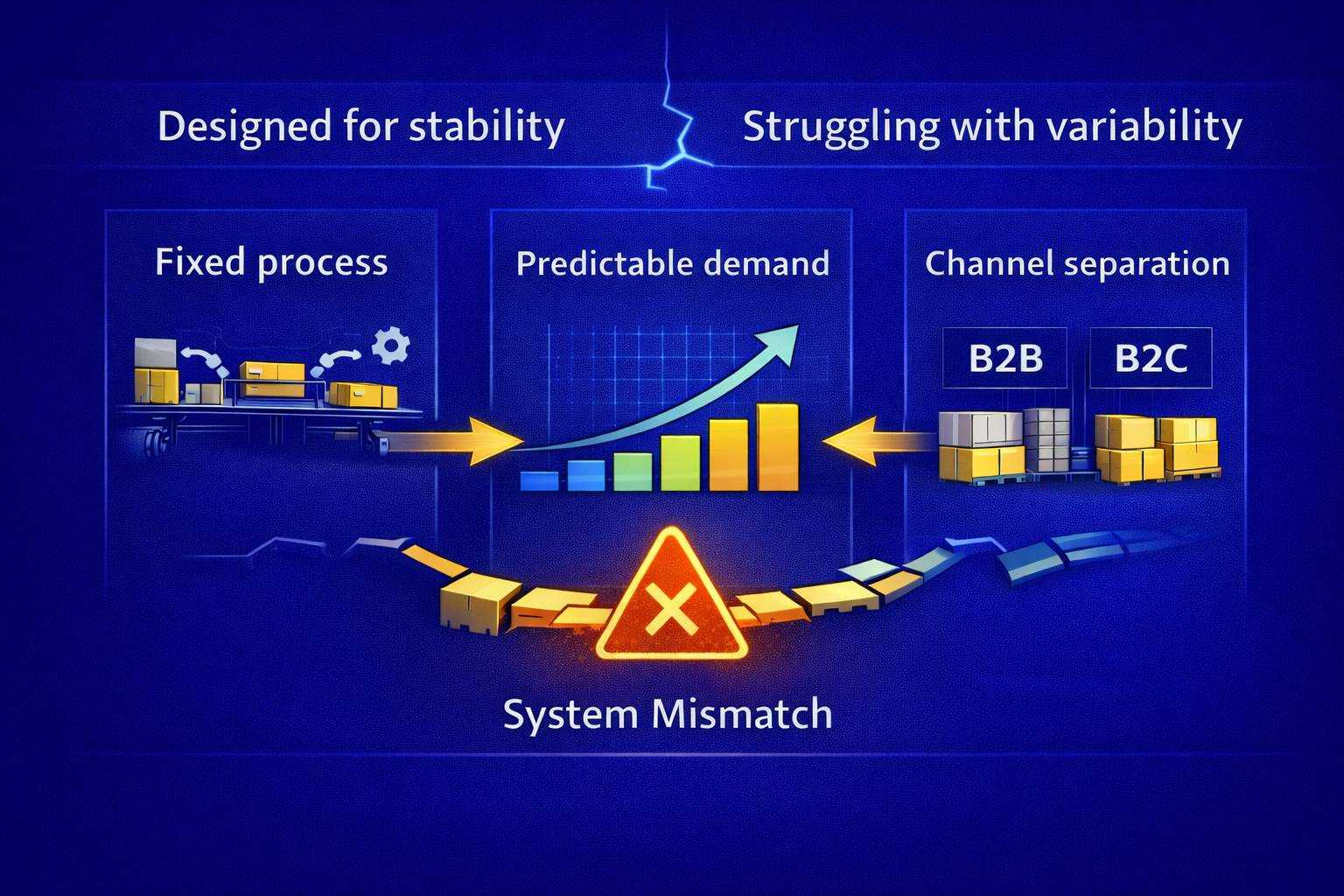
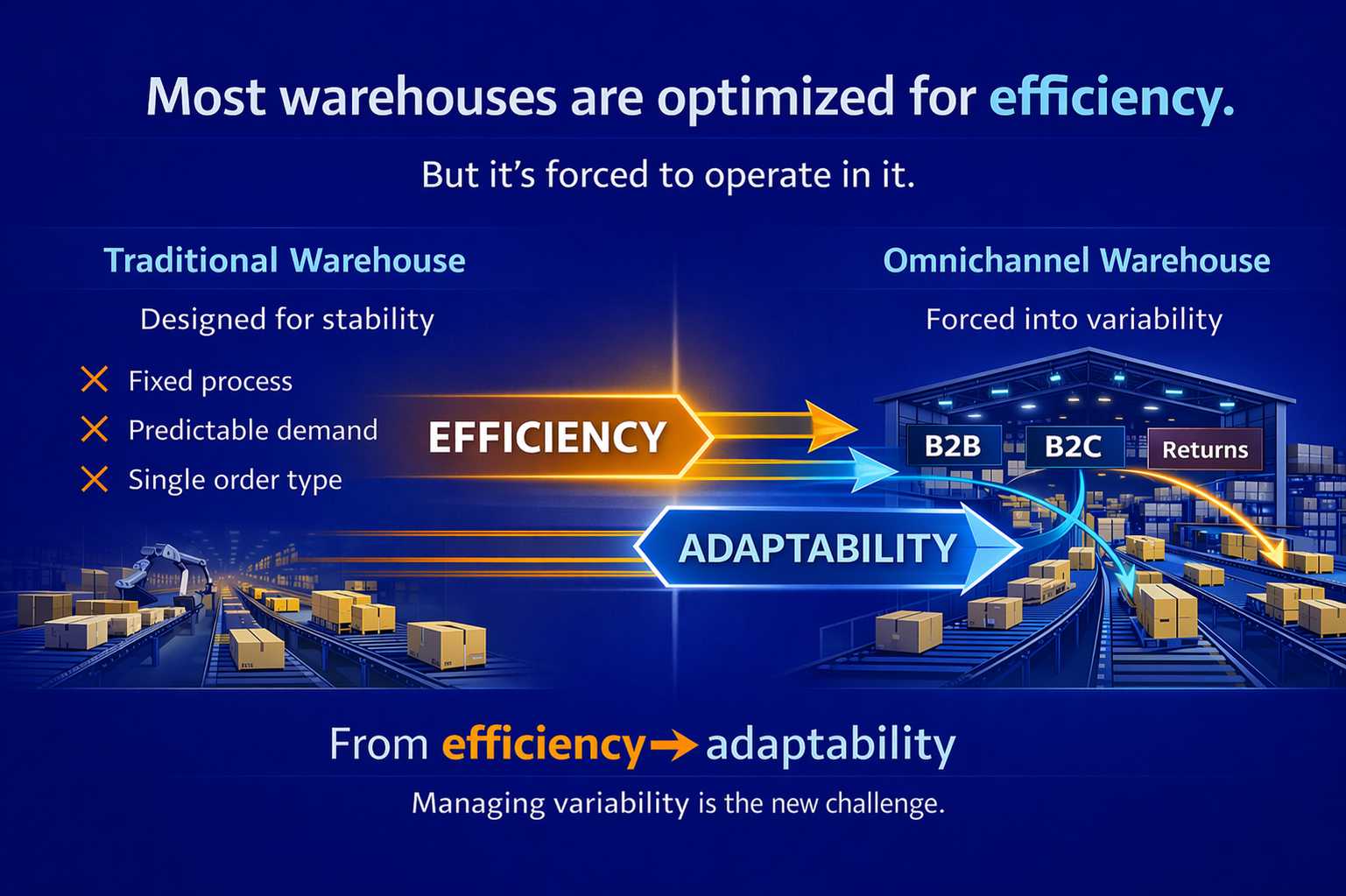
Most traditional warehouse systems are highly optimized, but they are optimized for a different set of assumptions. These systems were designed under conditions where demand was relatively stable, workflows were predictable, and channels could be managed independently. Legacy inventory management systems were built for this channel-separated approach.
Under omnichannel conditions, these assumptions no longer hold.
First, traditional warehouses rely heavily on fixed processes. Picking routes, packing procedures, and replenishment cycles are designed for consistency and efficiency. However, when order profiles change continuously throughout the day, fixed processes become difficult to maintain without manual intervention or performance trade-offs.
Second, these systems depend on predictable demand. Forecast-driven planning assumes that historical patterns can reliably inform future operations. In omnichannel environments, demand is influenced by multiple dynamic factors — promotions, channel-specific behavior, and shifting consumer expectations — making it significantly harder to plan resources effectively. A traditional inventory management system struggles to accommodate this level of real-time complexity without advanced inventory management software.
Third, traditional warehouses separate operations by channel. While this approach once improved efficiency and control, it now creates fragmentation. Inventory assigned to one channel cannot easily be reallocated when demand shifts, and resources dedicated to specific workflows cannot be redeployed quickly. This highlights the fundamental difference in multichannel vs omnichannel operational design.
Conclusion: Traditional warehouses are not failing because they are inefficient; they are failing because they were designed for an operational environment that no longer exists.
Complexity is no longer isolated — it is systemic
The complexity introduced by omnichannel fulfillment does not originate from a single factor. Instead, it emerges from the interaction of several structural trends that are reshaping the apparel industry and requiring deeper supply chain integration.
The first is the rapid growth of SKUs combined with increasing demand volatility, which forces warehouses to manage a far greater range of inventory combinations and order scenarios.
The second is the rise of returns as a constant operational flow, particularly in apparel e-commerce, where return rates can be significantly higher than in other industries.
Turning Apparel Returns Bottlenecks into Smoother Operations
The third is the growing importance of reverse logistics, which is increasingly central to both operational efficiency and sustainability initiatives.
Reverse Logistics in Circular Fashion: Sustainable Warehousing Solutions for Apparel Returns
Individually, each of these challenges can be addressed through targeted improvements. However, when they occur simultaneously within the same system, they create a level of complexity that is fundamentally different from traditional warehouse environments and often exceeds the capabilities of conventional warehouse management system architectures.
Why scaling resources is no longer enough
For many years, warehouse challenges were addressed by scaling existing resources. When demand increased, companies added more labor, expanded warehouse space, or introduced additional equipment to improve throughput. Many brands also turned to third-party logistics providers to handle overflow capacity.
While these approaches were effective in relatively stable environments, they become less effective under omnichannel conditions.
Adding more labor increases coordination complexity and can lead to inefficiencies when workflows are constantly changing. Expanding warehouse space often results in inventory being spread across larger areas, which can slow down response times and reduce operational agility. Introducing additional systems or equipment may improve capacity but often reduces flexibility, especially when those systems are designed for specific workflows. Even advanced inventory management software cannot fully compensate for structural limitations in warehouse design.
Key insight: Scaling capacity does not solve variability — and in some cases, it amplifies operational challenges.
The issue is no longer whether a warehouse has enough capacity, but whether it can adapt to changing conditions with proper inventory visibility and real-time inventory tracking capabilities.
The collapse of channel-based warehouse design
One of the clearest indicators of this shift is the decline of channel-based warehouse design.
Traditionally, separating operations by channel provided clarity and control. B2B orders could be processed in bulk, B2C orders could be handled independently, and returns could be managed in separate workflows.
In an omnichannel environment, this separation becomes a limitation.
Inventory must be shared across channels to respond to real-time demand. Resources must be flexible enough to shift between different types of work. Workflows must operate simultaneously without interfering with each other. Modern omnichannel fulfillment strategy requires capabilities like ship from store and unified inventory management that transcend traditional channel boundaries.
Core insight: Channel-based warehouse design becomes unsustainable when inventory and operations are fully integrated.
What once improved efficiency now creates friction, as separate systems are forced to coexist within the same operational environment.
What this means for apparel brands
For apparel and footwear brands, these changes have direct business implications. When warehouse systems cannot adapt to omnichannel complexity, inefficiencies begin to accumulate.
Inventory becomes harder to allocate effectively, leading to both stockouts and excess stock. Fulfillment performance becomes inconsistent, affecting delivery times and customer satisfaction. Operational costs increase as teams attempt to manage complexity through manual coordination and workarounds.
Over time, these issues impact more than just operations. They affect the ability of brands to scale, launch new channels, and respond to market opportunities.
Business insight: Operational limitations ultimately become growth limitations.
A different kind of warehouse is required
As omnichannel fulfillment continues to evolve, it becomes clear that traditional approaches are no longer sufficient. The focus is shifting away from optimizing individual processes and toward designing systems that can handle complexity more effectively.
This does not necessarily mean doing more, but doing things differently.
Warehouses must be able to handle different types of orders within the same environment, respond to demand changes in real time, and operate across channels without creating bottlenecks or inefficiencies.
The key shift is from efficiency to adaptability.
What comes next?
Understanding why traditional warehouse models are breaking is an important first step. The next question is how leading apparel brands are adapting their operations to meet these new challenges.
Explore how omnichannel fulfillment challenges are addressed in practice: How Omnichannel Fulfillment Challenges Are Addressed in Fashion and Footwear